

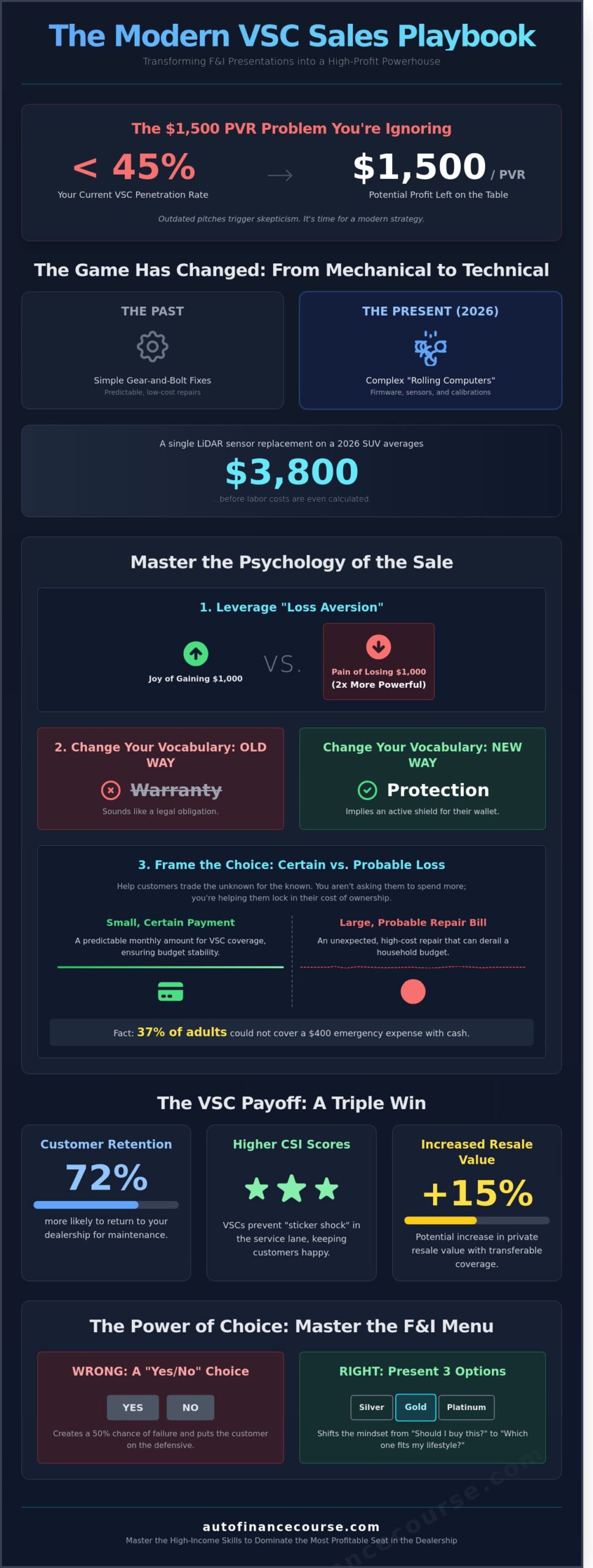
If your VSC penetration rate is currently hovering below 45 percent, you are essentially leaving $1,500 in potential PVR on the table with every single turn. Most F&I managers struggle because they rely on outdated pitches that trigger immediate customer skepticism. You need a modern strategy to overcome the “warranty” stigma and start closing more deals. Mastering these specific tips for selling extended vehicle service contracts will transform your presentation from a defensive hurdle into a value-driven consultation that customers actually respect.
We agree that hitting your monthly targets feels like an uphill battle when customers arrive with a “no” already on their lips. It’s time to change the game. This article promises to give you the psychological framing and technical scripts required to skyrocket your penetration rates and maximize your profitability. You will learn how to handle objections with total confidence and command the F&I menu like a seasoned expert. We are diving into the ten essential strategies that will define the top earners in 2026 and help you build a lucrative, high income career starting today.
A Vehicle Service Contract (VSC) is your customer’s primary shield against the financial volatility of modern car ownership. It’s a formal legal agreement between the vehicle owner and a provider to cover specific repair costs once the factory coverage expires. Don’t confuse this with a manufacturer warranty. While the factory warranty is a promise from the maker that the car will work, a VSC is a customizable service product designed for the long haul. In 2026, mastering the nuances of these contracts is essential for anyone looking for tips for selling extended vehicle service contracts effectively. These products are now the primary profit driver for any elite F&I department.
The days of simple gear-and-bolt fixes are over. In 2026, vehicles are essentially rolling computers. Advanced Driver Assistance Systems (ADAS) and Electric Vehicle (EV) drivetrains have completely transformed the service bay. Industry data projects that a single LiDAR sensor replacement on a 2026 SUV now averages $3,800 before labor costs are even calculated. The term “bumper-to-bumper” is now a misnomer. Modern coverage must account for code resets, firmware updates, and complex sensor calibrations rather than just physical metal parts. Learning the best tips for selling extended vehicle service contracts allows you to position these high-tech costs as avoidable risks for the buyer.
Your Profit Per Vehicle Retailed (PVR) lives and dies by your VSC penetration rate. High-performing managers target a 50% or higher attachment rate to maximize department revenue and ensure the dealership’s long-term health. Beyond the initial commission, VSCs secure the service drive. Consider these benefits for the dealership:
Unlock your potential by treating every VSC as a tool for customer retention. When you master the presentation, you aren’t just selling a piece of paper; you’re selling a guarantee that the customer’s 2026 technology remains functional without breaking their bank account.
Mastering the psychology of the sale is how you unlock your full income potential in the F&I office. Top producers understand that customers don’t buy parts; they buy security. This starts with Loss Aversion. Research in behavioral economics shows that the pain of losing $1,000 is twice as powerful as the joy of gaining $1,000. When you apply this to car repairs, you stop selling a product and start selling a solution to a future crisis.
Stop using the word “warranty” immediately. It sounds like a legal obligation or a manufacturer’s promise. Switch your vocabulary to “protection” or “coverage.” These words imply an active shield for the customer’s wallet. Use the “Certain Loss vs. Probable Loss” framework to close more deals. A 2023 Federal Reserve report indicated that 37% of adults could not cover a $400 emergency expense with cash. By framing the VSC as a small, certain monthly payment, you eliminate the threat of a large, probable repair bill that could derail their entire household budget.
One of the most effective tips for selling extended vehicle service contracts is focusing on budget stability. You aren’t asking them to spend more; you’re helping them lock in their cost of ownership. Trade the unknown for the known. This strategy turns a defensive customer into a partner in financial planning.
Don’t bore your customers with a list of covered components like gaskets or sensors. Describe the physical feeling of walking away from the service counter with a $0 bill while others are shelling out $4,500 for a transmission failure. Sell “Peace of Mind” as a tangible asset they can take home. Position the VSC as an investment in the vehicle’s future. Data shows that vehicles with documented service contracts can see a 15% increase in private resale value because the coverage is often transferable to the next owner.
Presenting a single “Yes/No” choice creates a 50% chance of failure. Instead, present three distinct options. This shifts the customer’s mindset from “Should I buy this?” to “Which one of these fits my lifestyle?” Use “Decoy Pricing” by placing a high-end “Platinum” plan next to a “Gold” plan. This makes the mid-tier option look like an incredible value. Anchoring is a psychological tool where the first price presented serves as a mental benchmark for all subsequent negotiations. If you want to master these high-level F&I skills, you must practice these presentations until they are second nature.
Mastering the art of the presentation is what separates average earners from high-income professionals. You need a repeatable, disciplined roadmap to drive consistent results. These five steps provide the structure you need to dominate the F&I office and increase your back-end profit per deal. Follow this proven sequence to refine your tips for selling extended vehicle service contracts and close more deals.
Success begins with the right questions. Don’t ask “Yes” or “No” questions. Instead, use diagnostic inquiries to build your case. Ask the customer: “How long do you plan on keeping this vehicle?” If they say five years, you know exactly which terms to highlight. Follow up with: “If you had a $3,000 repair bill tomorrow, would you pay cash or use a credit card?” Their answer tells you if they value liquid cash or need to avoid high-interest debt. Use these answers to customize the “Why” of the VSC later in the process. You aren’t selling a product; you’re selling a solution to their specific financial reality.
Keep your presentation visual and fast-paced. Use a clean, digital menu that highlights “Total Protection” as the primary choice. Data from 2024 shows that 82% of consumers prefer visual aids over verbal explanations alone. When implementing tips for selling extended vehicle service contracts, you must utilize the “Power of No.” If a customer declines, ensure they understand exactly what they’re opting out of. Make them physically acknowledge that they’re choosing to be 100% liable for all mechanical and electronic failures. This level of professional transparency is exactly what an F&I manager does to maintain high CSI scores while maximizing profitability. Master the menu, and you master your income.
This is the number one objection you’ll face in the F&I office. It’s a wall built on past experiences with simpler machines. To break it down, you must master the “Feel, Felt, Found” method. Acknowledge their skepticism. It validates their perspective and lowers their guard immediately. When you align with the customer, you stop being a salesperson and start being an expert consultant.
Stop selling a “warranty” and start selling “Health Insurance for your car.” Nobody wants to use their medical insurance, but they’re glad it’s there when a $50,000 bill arrives. Frame the VSC as a tool to protect their financial peace of mind. Remind them that a transferable contract increases the car’s resale value. In 2026, a buyer will pay a premium for a used car that comes with guaranteed protection. These are essential tips for selling extended vehicle service contracts to savvy buyers who care about their long-term profitability.
“I understand you never used a service contract on your 2010 model. However, your 2010 model didn’t have 45 separate computer modules. This 2026 model is a rolling supercomputer.” Modern repairs are rarely just mechanical. They’re software driven. A single blind-spot sensor recalibration now costs upwards of $1,850. If that chip fails, your safety systems go dark. One repair pays for the entire investment.
Stop talking about the total price. Break it down to the daily impact. A $3,000 VSC over a 72-month term adds about $41 to the monthly payment. That’s $1.36 per day. You can’t even buy a small coffee for $1.36 in 2026. Compare that tiny daily cost to a $7,200 transmission replacement or a $4,500 infotainment screen failure. By rolling the cost into their low-interest financing, they protect their savings account from massive, unexpected hits. Use these tips for selling extended vehicle service contracts to turn a “no” into a “yes” and secure your success.
Ready to dominate the dealership floor? Master advanced closing techniques and skyrocket your PVR today!
Mastering the F&I office is the fastest way to change your financial future. It’s the highest-grossing department in any dealership. You shouldn’t view yourself as just another salesperson. You’re a professional finance expert. This transition is one of the essential tips for selling extended vehicle service contracts because customers value expertise over a pitch. VSC sales are a technical skill. You can learn them. You can master them. You can turn every “no” into a “yes” by using a structured, psychological approach.
Stop “learning on the fly.” It’s a recipe for disaster. An untrained manager typically loses $800 in back-end profit on every fifth deal. That adds up to over $40,000 in lost revenue annually. In 2026, federal regulations and consumer protection laws are stricter than ever. Mistakes lead to chargebacks or legal headaches. A comprehensive F&I course eliminates the guesswork. It gives you a step-by-step roadmap to success.
You’ll learn to navigate complex paperwork while maintaining a 95% CSI score. Professional training ensures you stay compliant while you maximize your income potential. It’s about building a sustainable career, not just hitting a monthly quota. When you have a roadmap, you move with confidence. That confidence is what closes the most difficult customers in the 2026 market.
Are you ready to drive your career forward? The difference between a $60,000 salary and a $150,000 income is specialized knowledge. Auto Finance Course provides 180-day access to industry-leading training. You’ll get the exact scripts and strategies used by the top 5% of managers nationwide. These are job-ready skills you can use the moment you step into the office. Dealerships are looking for experts, not amateurs.
Don’t wait for success to find you. Take control of your trajectory today. Investing in your education is the only way to guarantee a high income career in the automotive industry. Browse all courses and start your journey toward becoming a top-performing manager. Your future self will thank you for the commitment you make right now.
The 2026 automotive market demands a shift from traditional sales to expert consultation. You’ve learned how psychological framing and a structured 5-step presentation can transform your F&I office performance. These tips for selling extended vehicle service contracts give you the edge needed to handle the 48% of customers who initially decline coverage. By mastering these specific techniques, you’re providing a critical financial safety net for modern drivers while boosting your dealership’s profitability.
Are you ready to stop guessing and start earning? Our training is built from 15 years of real-world F&I office experience to ensure you master every deal. You’ll receive 180 days of access to master finance, insurance, and compliance protocols. This is your chance to position yourself for a career with $100,000 plus earning potential. Take control of your professional future right now. Master F&I Sales and Build a High Income Career. Enroll Now!
Your journey to the top of the dealership leaderboard starts with a single decision today. We’re excited to see you thrive and reach your full potential in the F&I office.
A warranty is a manufacturer’s promise included in the vehicle’s original purchase price, while a VSC is a separate, optional agreement you choose to buy. A standard manufacturer warranty usually expires after 3 years or 36,000 miles. A VSC can extend that vital protection for up to 10 years or 150,000 miles. Think of the warranty as the factory foundation and the VSC as the complete safety net for your financial investment.
Expect to earn between $350 and $850 in commission for every VSC you sell in a high-performing F&I office. Top-tier managers often see 18% to 22% of the gross profit from the contract as their personal take-home pay. Mastering these tips for selling extended vehicle service contracts can push your monthly income past the $14,000 mark. It’s a direct path to financial success and a prestigious career in the automotive industry.
You can absolutely sell a VSC on used vehicles with up to 160,000 miles or 20 years of age. Most providers offer “stated component” or “powertrain plus” plans specifically for these high-mileage units. These contracts protect buyers from $4,500 engine failures or $2,800 transmission swaps. Selling protection on older cars is a massive opportunity to increase your dealership’s profitability and help customers avoid crippling debt. It’s about providing value at every stage.
VSCs typically boost dealership CSI scores by 12 to 18 points because they eliminate the frustration of unexpected repair bills during service visits. When a customer’s $1,200 AC compressor is covered by a small $100 deductible, they leave the dealership feeling protected. Happy customers provide 5-star reviews and return for their next purchase. Your reputation as a master F&I manager depends on providing this long-term peace of mind and building lasting trust.
Most 2026 contracts prioritize advanced electronics, EV batteries, and autonomous driving sensors alongside traditional powertrain components. You’ll find comprehensive coverage for LiDAR systems, 15-inch infotainment screens, and electric drive motors. These high-tech parts often cost over $3,500 to replace at current rates. Modern VSCs are designed to shield owners from the soaring costs of 2026 automotive technology and complex software failures that standard warranties might miss after the first few years.
It’s ethical and standard practice to include the VSC cost in the vehicle loan as long as you provide full disclosure of the monthly payment impact. Most lenders allow a Loan-to-Value (LTV) ratio of up to 125% to accommodate these protective products. This allows the customer to safeguard their vehicle for an extra $18 to $32 per month. It’s a smart financial move that prevents them from needing high-interest credit cards for emergency repairs later.
The customer can either transfer the VSC to the new private buyer for a $50 administrative fee or cancel it for a pro-rated refund. Transferring the contract can increase the vehicle’s resale value by $1,200 or more because the new owner gains instant peace of mind. If they choose to cancel, the refund is typically calculated based on the remaining months or miles. This flexibility makes the VSC a risk-free investment for any savvy car buyer.
You can increase your closing ratio by 22% in 30 days by implementing a structured 300-percent rule menu presentation. Present 100% of the products to 100% of the customers 100% of the time. Use real-world repair data from your service department to show local labor rates of $195 per hour. Consistent practice and following proven tips for selling extended vehicle service contracts will unlock your full income potential and drive your career forward immediately.