

Are you tired of the feast-or-famine paychecks? Do you spend long hours on the sales floor only to see your income stall, trapped by a confusing draw-versus-commission plan? The dream of a high-income automotive career feels distant when you’re just trying to make it to the end of the month. Understanding the real car sales average pay for 2026 is the first step to breaking free. But average isn’t your destination-success is.
This is your roadmap. We will expose the actual earnings potential, from entry-level sales to the dealership’s profit center: the F&I office. You will discover the critical difference between volume and gross-based pay plans and, most importantly, learn the actionable steps to bridge the gap between “average” and the sought-after, $150k+ F&I manager role. It’s time to stop guessing about your income potential and start building the high-income career you deserve. Are you ready?
Are you aiming for an average career or a high-income future? While industry projections place the car sales average pay in 2026 between $55,000 and $85,000 annually, this figure is dangerously misleading. In a performance-driven industry, “average” is a benchmark you should plan to shatter, not settle for. Your actual income potential is not defined by a national statistic but by your skill, your drive, and the structure of your pay plan.
Unlike a standard salaried job, compensation for an Automobile salesperson is built on performance. Understanding the core pay structures is the first step to maximizing your earnings:
Furthermore, the rise of digital retailing is reshaping the role of the floor salesperson. As more of the buying process moves online, dealerships are adapting compensation to reward professionals who can manage leads and facilitate transactions both online and in-person, making a static car sales average pay figure even less relevant.
Your dealership’s philosophy directly impacts your wallet. Many large, corporate dealer groups are shifting to “volume flats”-a fixed dollar amount per vehicle sold (e.g., $200). This model favors beginners by making income predictable. In contrast, traditional gross-profit commissions (e.g., 25% of front-end profit) massively reward seasoned pros who can hold high gross on every deal. Master your craft, and the gross-based plan will unlock a six-figure income.
A “draw” can feel like a salary during your first 90 days, but it’s not. A draw against commission is a recoverable advance on future earnings. If your commissions don’t cover your draw, you owe the difference. While a high base salary seems safe, it’s often a trade-off for a much lower commission percentage, effectively capping your income. True top performers embrace commission-heavy plans because they are confident in their ability to produce results.
Forget a simple salary. To unlock your maximum income potential on the sales floor, you must master the modern pay plan. It’s a dynamic structure built to reward elite performance, not just time on the clock. While government sources like the BLS Occupational Outlook Handbook provide a wide view of retail compensation, the reality at a successful dealership is far more nuanced and aggressive. The typical car sales average pay is just a starting line; top earners understand how to leverage every part of their pay plan.
Your monthly check is a combination of several key performance metrics:
In today’s market of transparent pricing, deals with little to no gross profit are inevitable. This results in a “mini”-a minimum flat commission of around $150. The real opportunity for a massive commission, or a “home run,” often lies in used cars, where the potential gross profit can dwarf that of a new vehicle. Your key to maximizing profit is mastering the trade-in negotiation and building powerful rapport that adds value beyond the price tag.
This is your secret weapon for a higher income. OEMs (Original Equipment Manufacturers) like Ford, Toyota, and others pay salespeople directly to sell specific models. These “spiffs” or “spin” programs are often paid via a debit card, acting as a second paycheck. In 2026, these incentives are more data-driven than ever, designed to move targeted inventory. Mastering these programs is essential for anyone looking to shatter the standard car sales average pay.
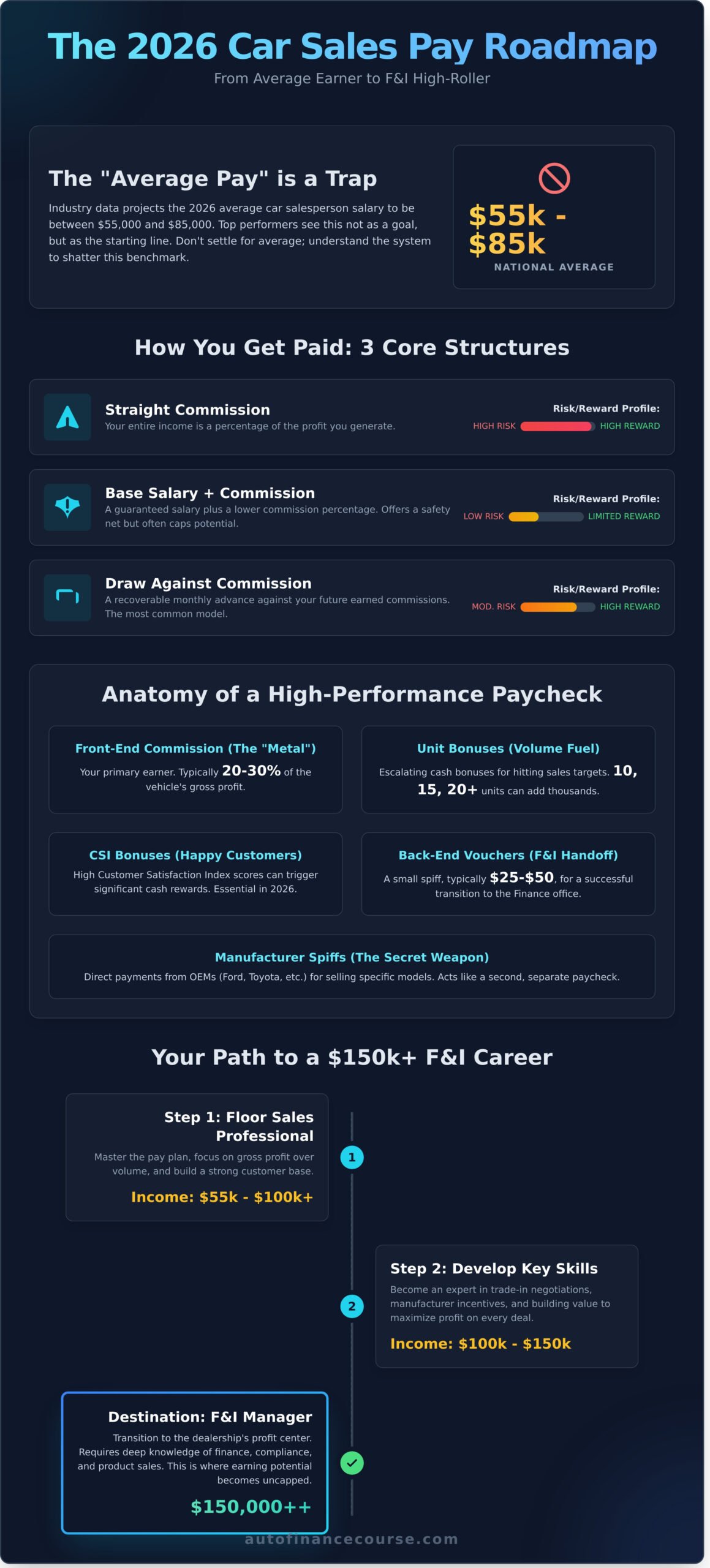
When comparing the car sales average pay to an F&I manager’s earnings, the difference isn’t just a gap-it’s a chasm. While a talented salesperson can make a good living, they often hit an income ceiling dictated by inventory, foot traffic, and front-end gross profit. Data from the U.S. Bureau of Labor Statistics provides a baseline for retail auto sales wages, but top F&I professionals operate in a completely different financial stratosphere. The F&I office isn’t just a job; it’s the dealership’s most powerful profit center, offering superior income potential, job stability, and professional prestige.
The secret to F&I’s immense earning potential lies in one key metric: Per Vehicle Retail (PVR). This is the average profit generated from finance and insurance products for every car sold. While a salesperson earns a commission on the vehicle’s margin, an F&I manager earns a percentage of a much larger, more profitable pool. Their income is driven by high-margin ancillary products, including:
Dealerships prioritize F&I profitability because it often surpasses the profit made on the vehicle itself. A skilled F&I manager who can master product presentation and compliance directly controls the dealership’s bottom line-and is compensated accordingly.
Are you a top-performing salesperson wondering why you haven’t been promoted? Often, the best salespeople get “stuck” on the floor precisely because they are too valuable at selling cars. Management is reluctant to move a consistent top performer and risk disrupting front-end sales. This is where you must take control of your career trajectory.
Waiting for an internal promotion is not a strategy for success. The fastest way to force management’s hand and secure your high-income career is through external, specialized training. Proving you have mastered the necessary skills before you get the job makes you an asset they cannot ignore. This is the key shortcut, and our guide on how to become an auto F&I manager provides the exact roadmap. For a deeper dive into the numbers, explore our comprehensive F&I Manager Salary Guide and see the potential for yourself.
The national car sales average pay is merely a benchmark. Top performers-those destined for the F&I office-know their income isn’t dictated by averages but by key variables. Your potential is a direct result of the environment you choose and the skills you master. It’s time to take control of your career trajectory.
Your income is immediately shaped by your environment. A salesperson in a high-cost area like Los Angeles will see different numbers than one at a rural volume store. The brand also matters. Import brands often rely on high sales volume, while luxury brands like Porsche focus on high-gross profit per unit. Finally, a dealership’s ownership-a private store versus a public group like AutoNation-determines the pay plan, culture, and career path.
The most critical factor is you. In today’s market, anyone can be an “order taker.” True professionals are “closers.” They build value, overcome objections, and maximize profit on every deal. This skillset is what separates a six-figure salesperson from someone just getting by and is the absolute foundation for a high-income career in F&I.
This is the classic dealership debate. Luxury stores operate on a “low volume, high gross” model, where a few sales yield massive commissions. Volume stores live by the “high volume, low gross” rule, requiring more unit sales. For a beginner in 2026, a volume store is the superior training ground. You’ll get more at-bats, master the sales process faster, and build the skills needed to dominate any environment.
Your digital reputation is your modern-day resume. Customer Satisfaction Index (CSI) scores are no longer vanity metrics; they are directly tied to your bonus. A single “bad” survey from the manufacturer can cost you hundreds in lost income. The key to high CSI is simple: under-promise and over-deliver. Master setting clear expectations with customers from the start to protect your profitability and build a loyal client base.
While location and brand set the stage, your skill set determines your success. The gap between the car sales average pay and the elite income of an F&I Manager is built on mastering a repeatable process for sales and profitability. When you’re ready to learn the expert-level skills that define a high-income career, the path forward is clear.
You’ve seen the numbers. The gap between the car sales average pay and the income of a top-performing F&I Manager is not just a gap-it’s a chasm. But crossing it doesn’t happen by accident. It happens by design. The sales floor is your training ground, but the F&I office is where a true high-income career is built. It requires a strategic move, armed with specialized skills that dealerships are actively seeking.
Making that leap requires mastering the three pillars of the finance office: advanced finance principles, credit analysis, and-most critically-legal compliance. This is the expert knowledge that separates the six-figure earner from the average salesperson.
In today’s highly regulated automotive industry, “learning on the job” is a slow and risky path that most dealerships can no longer afford. General Managers demand F&I professionals who can step in and perform from day one, protecting the dealership from costly compliance violations while maximizing profitability. Our Online F&I Training Course is engineered to make you that candidate, equipping you with job-ready expertise in just a few weeks.
Viewing this training as a cost is the wrong mindset. It’s an investment in your future earning potential-an investment that typically pays for itself within the first month of your new F&I role. Are you ready to stop settling for the limits of the car sales average pay and start building the life you deserve? Your potential is waiting to be unlocked.
The roadmap to your high-income career in automotive finance is clear. Take the first step and commit to your success.
Enroll in the Auto Finance Course today!
As we’ve explored, the world of auto sales presents a clear choice. You can remain on the sales floor, bound by unpredictable commissions, or you can take control of your financial future in the F&I office. The crucial takeaway is that you don’t have to settle for the standard car sales average pay. Your earning potential is a direct result of the specialized skills you bring to the dealership’s most profitable department.
Are you ready to make the leap? Our training is the definitive pathway to success. Built from real-world F&I office experience, our program provides complete training on finance, credit, and compliance. With 180 days of comprehensive digital access, you get the expert skills required to become a top-performing manager.
Master the skills to escape the floor and become a high-earning F&I Manager today!
Your future is in your hands. It’s time to accelerate your career and unlock your true potential.
Absolutely. In 2026, car sales remains a powerful entry point for a high-income automotive career. It is a performance-based role where your skills directly dictate your earnings and potential. For ambitious individuals, it serves as the ultimate training ground for mastering the sales expertise and dealership experience required to advance. Master the sales floor, and you unlock the direct pathway to more lucrative positions, such as a top-performing F&I Manager, where your income potential truly multiplies.
The top 1% of car salespeople are elite performers who have mastered the art of the sale and consistently shatter income expectations. These high-achievers can earn well over $250,000 annually, with some pushing past the $400,000 mark at high-volume or luxury brand dealerships. Their success is the result of expert negotiation, relentless follow-up, and a deep understanding of customer psychology, proving the immense potential within the role for those with exceptional drive.
Most modern car sales pay plans are a hybrid model. While some “old-school” dealerships might be commission-only, the industry standard today is a modest base salary or a “draw” combined with a commission on the gross profit of each sale. This structure provides a small safety net while heavily rewarding high performance. Your goal as a sales professional should always be to earn far more in commission than you receive in base pay or from a draw.
Expect to invest significant time to achieve a high income in car sales. The standard workweek is often 50-60 hours, including evenings and weekends when customer traffic is at its peak. This is not a typical 9-to-5 job; it’s a career that rewards dedication and availability. Top earners understand that more time on the sales floor and engaging with clients directly translates to more deals closed and higher commissions earned. The hours are demanding, but the financial returns are there for the committed.
The income difference is substantial and represents a major career leap. While the car sales average pay provides a good living, an F&I Manager’s income potential is in another league entirely. A successful salesperson might earn $70,000-$100,000, but a skilled F&I Manager consistently earns $150,000 to over $250,000. F&I Managers generate significant profit per vehicle through finance and insurance products, making them one of the highest-paid professionals in any dealership.
Yes, earning six figures is an achievable goal for a skilled and motivated car salesperson. Crossing the $100,000 threshold requires consistent performance, a powerful work ethic, and the ability to sell 12-15+ cars per month. While this is significantly higher than the typical car sales average pay, it is a common benchmark for success in the industry. Reaching this income level proves you have the drive and skills necessary to potentially advance into an even more lucrative F&I role.
A “draw” is an advance or a short-term loan from the dealership against your future earned commissions. For example, you might receive a $2,000 draw every two weeks. If you earn $3,000 in commission during that period, you are paid the $1,000 difference. However, if you only earn $1,500, you owe the dealership the $500 shortfall. It ensures you have some cash flow but reinforces the performance-driven nature of the career where results are paramount.
In 2026, AI hasn’t replaced salespeople; it has empowered the elite. AI-driven CRM tools now predict which past clients are most likely to re-purchase and when, allowing top salespeople to focus their efforts with surgical precision. This technology automates lead qualification and initial follow-up, freeing up valuable time for closing high-profit deals. As a result, commissions for tech-savvy salespeople have increased, as they can manage a larger, higher-quality pipeline with far greater efficiency.