

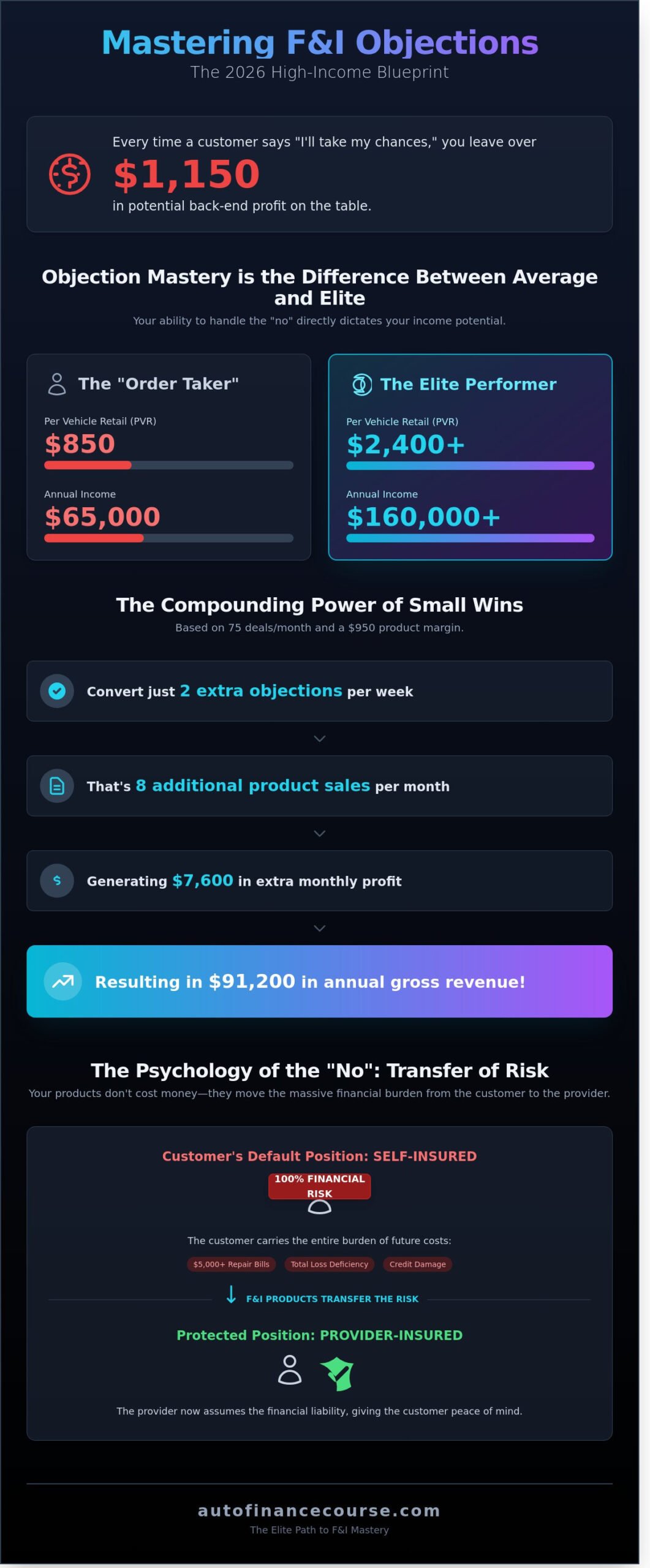
Every time a customer says “I’ll just take my chances” and walks out without coverage, you’re likely leaving over $1,150 in back-end profit on the table. It’s a staggering loss that separates average performers from the elite earners. You’ve probably felt that hesitation when a presentation hits a wall, worrying that pushing harder will tank your CSI scores or make you look desperate. It’s a common struggle, but it doesn’t have to be your reality. Mastering the art of overcoming objections in the f&i office is the single fastest way to unlock your full income potential and project the professional authority you deserve.
We’ve built this 2026 master guide to give you the elite psychological frameworks and closing techniques used by the top 3% of F&I managers nationwide. You’re going to learn a repeatable process for every common resistance point, ensuring you never feel “pushy” again. We’ll show you how to turn a firm “No” into a high-profit “Yes” while actually increasing your customer satisfaction ratings. This article previews the exact roadmap you need to increase your monthly commission and build the high income career you’ve always wanted.
Your career trajectory in the automotive world isn’t dictated by luck. It’s driven by your ability to handle the “no.” In the 2026 dealership environment, overcoming objections in the f&i office has evolved into a high-level form of consultative problem-solving. You aren’t there to pressure people or win an argument. You’re there to provide solutions to financial risks they haven’t even considered yet. This mastery is the direct line to your financial freedom and professional prestige.
The correlation between objection mastery and your PVR (Per Vehicle Retail) profit is absolute. An “order taker” is someone who simply prints the paperwork the customer wants. They usually see a PVR of $850 and an annual income of $65,000. Contrast that with a top-performing F&I Manager. These professionals use advanced techniques to maintain a PVR of $2,400 or higher. That difference translates to an income bracket exceeding $160,000. If you want the high-income lifestyle, you have to master the high-income skills. You need to be the person the dealer principal trusts with their most difficult customers.
Top earners focus on these three pillars to drive results:
A single product sale might seem small, but the cumulative effect is massive. If you process 75 deals per month, converting just two additional objections per week adds 8 product sales monthly. At a $950 margin, you’ve generated $7,600 in extra monthly profit. This results in $91,200 in annual gross revenue. This is why 88% of dealership owners headhunt managers who can handle tough customers and boost personal commissions.
Moving to the box requires a total psychological reset. On the floor, you have hours to build rapport. In the finance office, you have a 30-minute window to establish authority. You must master The AIDA process to build desire for products like GAP or Service Contracts quickly. You’re now a financial consultant, not just a salesperson. This shift in mindset is what creates elite earners.
The F&I office remains the most profitable room in the entire dealership. If you can master the art of the rebuttal and the psychology of the “no,” you’ll never be without a high-paying job. Are you ready to unlock your full earning potential? Check out our ultimate career explainer to see how you can start your journey today.
Every “no” you hear in your office is a defense mechanism. It isn’t a personal rejection of you or your expertise. It’s a reaction to a perceived threat. When a customer enters the F&I office, they’re often at the peak of their stress. They’ve just spent hours negotiating a car deal. Now, they’re facing a professional whose job is to protect the dealership’s profitability. At its core, every objection is rooted in a fear of the unknown. They fear overpaying. They fear buying something they won’t use. They fear losing control of their budget.
To master overcoming objections in the f&i office, you must grasp the “Transfer of Risk” principle. Right now, the customer carries 100% of the financial liability for mechanical failures, total losses, or credit hits. Your products don’t just “cost money”; they move that massive financial burden from the customer’s wallet to the provider. If a customer refuses a Service Contract, they’re choosing to self-insure a $5,000 repair. Your goal is to make them realize that keeping the risk is far more expensive than transferring it.
Logic and emotion are constantly at war during your presentation. Data from the 2023 Cox Automotive Car Buyer Journey study shows that 70% of the decision-making process is emotional. However, customers use logic to justify those emotional choices later. If you hear “I want to think about it,” you’ve failed to build value earlier in the process. This specific phrase is rarely about time; it’s a polite way of saying the value doesn’t yet outweigh the cost. You haven’t triggered the emotional need for security or the logical proof of savings.
Every objection has three distinct layers: The Statement, The Underlying Fear, and The Opportunity. When a customer says, “It’s too expensive,” that’s just the Statement. The Underlying Fear is often that they won’t see a return on their investment. This creates your Opportunity to pivot. Research into The Psychology of a ‘No’ suggests that top performers use active listening to isolate the root cause before reacting. Stop talking and start observing. Is their body language defensive? Are they leaning back or crossing their arms? Your desk presence must remain professional and calm to reduce this resistance. Maintain eye contact. Keep your workspace clean. Project the authority of a financial advisor, not a salesperson.
Success in F&I requires a repeatable system. The A.C.E. Method allows you to handle any resistance without becoming confrontational. It’s the roadmap for turning a “no” into a “yes.”
Mastering these psychological triggers is how you build a high-income career. If you’re ready to sharpen these skills and increase your PVR, you can explore professional certification options to stay ahead of the competition. Stop fearing the “no” and start leading the conversation.
Top-tier F&I managers don’t wait for a “yes.” They build it. Success in this high-stakes environment requires a tactical mindset that transforms resistance into revenue. Mastering the art of overcoming objections in the f&i office separates average employees from the elite managers earning $200,000 or more annually. You must treat every objection as a request for more information. When a customer pushes back, they’re actually revealing what they value. Your job is to align your products with those values through a disciplined, professional game plan.
One common hurdle is the “credit union” defense. When a buyer claims they can find a cheaper service contract at their local branch, lean on your professional authority. Explain that a 2023 industry analysis found that 74% of independent service contracts contain restrictive “tear-down” clauses or “betterment” charges. These hidden terms force customers to pay for labor or parts depreciation out of pocket. Your dealership products are integrated with the manufacturer’s diagnostic systems, ensuring a seamless repair process that third-party providers can’t match. You aren’t just selling a piece of paper; you’re selling a guaranteed relationship with the service department.
Stop looking at the total price. Start looking at the daily impact. A $40 increase in a monthly payment breaks down to exactly $1.33 per day. Ask the customer if they can find $1.33 in their daily budget to avoid a $4,200 engine control module failure. If the total payment remains a hard barrier, pivot immediately. Dropping from a “Platinum” to a “Silver” tier keeps the customer protected while lowering the cost. It’s better to secure partial coverage than to let them walk out with zero protection.
Reliability is a trap for the unprepared. Modern vehicles are computers on wheels, packed with over 1,500 semiconductor chips and dozens of delicate sensors. Remind the customer that manufacturers only offer a 36,000-mile limited warranty because they understand the failure rates of high-tech components. A single failure of the blind-spot monitoring system can cost $2,850 to replace. One repair event pays for the entire contract. You aren’t betting against the car’s quality; you’re protecting against the cost of its complexity.
The “Self-Insuring” objection requires a shift toward financial pragmatism. When a customer claims they’ll just pay for repairs as they go, ask them to identify the specific $5,000 liquid asset they’ve earmarked for mechanical failures. Most haven’t set this money aside. By rolling the protection into the financing, they’re using the bank’s money at a low interest rate to protect their own savings. This strategy preserves their cash flow and ensures that a single bad day at the repair shop doesn’t derail their financial stability.
Effective overcoming objections in the f&i office involves using real-world math to displace fear. Top performers treat every “no” as a puzzle to solve. When you master these specific turnarounds, you stop being a salesperson and start being an advisor. This level of expertise is what drives a high-income career in the automotive industry. By providing concrete data and logical comparisons, you remove the emotional barrier to the sale and provide the roadmap for the customer to protect their investment while you build your professional legacy.
Mastering the art of overcoming objections in the f&i office requires moving past basic rebuttals and into high-level psychological frameworks. You aren’t just selling a product; you’re selling a solution to a problem the customer hasn’t fully realized yet. Start using the Agreement in Principle. This framework involves getting the customer to agree on a broad concept, like the importance of financial security, before diving into the specifics of a Vehicle Service Contract. If they agree that protecting their $45,000 investment is smart, they’ve already logically committed to the product.
Effective professionals use the Menu as a strategic visual anchor rather than a simple price list. A 2023 study by Cox Automotive revealed that 72% of consumers value transparent pricing above almost all other factors. Use your menu to display options clearly. This naturally reduces friction. When a customer sees the “Preferred” and “Standard” packages side by side, their brain shifts from “Do I want this?” to “Which one fits me best?” This is the core of Assumptive Selling. You must operate under the assumption that every customer wants to protect their credit and their vehicle. Don’t ask if they want to hear about options. Tell them you’ve prepared three tailored ways to protect their new purchase.
Your success depends on your ability to maintain legal compliance while remaining a dominant closer. The 2024 FTC Safeguards Rule and the Equal Credit Opportunity Act of 1974 aren’t hurdles; they’re your protection. Being a “closer” means being a professional who respects the law while maximizing profit. If you’re serious about your future, check out this finance manager training your ultimate guide to a high income career to master these professional standards.
Budget certainty is the strongest psychological lever you have in the F&I office. Most customers live on a fixed monthly income where a surprise $2,000 repair bill would be a financial catastrophe. Show them the math. A customer might hesitate at a $45 monthly increase for a protection package, but you must frame this as “buying the ceiling.”
Never wait until the end of your presentation to ask for the sale. Use “temperature check” questions to gauge the customer’s mindset throughout the interview. Ask questions like, “Does having a $0 deductible for major repairs give you more peace of mind?” or “Based on your 15,000 annual mileage, does this coverage level seem to fit your needs?” These questions are vital for overcoming objections in the f&i office before they turn into a hard “No.”
Watch for buying signals. If a customer leans in to look at the menu or asks about the transferability of the warranty, they’re leaning toward a “Yes.” If a trial close fails, don’t panic. This is your cue to “Pivot” back to value. If they say the payment is too high, immediately move away from the price and back to the specific risk they mentioned earlier, such as the complex electronics in their new SUV. You must rebuild the “Why” before you can ask for the “How much” again.
Stop wasting money on the “trial by fire” method. Many aspiring managers believe they can learn the ropes while sitting across from real customers. This is a dangerous and expensive mistake. Learning on the job is the most costly training strategy in the automotive industry. Every time you stumble through a presentation or fail to address a concern effectively, you’re flushing profit down the drain. If an untrained manager loses just three product sales a week, they’re sacrificing roughly $2,400 in monthly commission. Over a full year, that’s more than $28,000 in personal income left on the table because of a lack of preparation.
Our structured online course eliminates this learning curve by providing 180 days of 24/7 access to elite training materials. You don’t just watch videos; you build a professional foundation based on 2024 industry standards. You’ll study the exact scripts and psychological triggers required for overcoming objections in the f&i office with confidence. By the time you complete the modules, you won’t just be looking for a job. You’ll be a “Job-Ready” asset that dealerships actively seek out. This is your definitive roadmap to a career earning between $100,000 and $200,000 per year. Mastering the office conversation is the only way to secure that level of financial freedom.
Dealerships don’t have the time or resources to babysit new hires. They want experts who can hit the ground running with a deep understanding of financing approvals, ancillary insurance products, and strict legal compliance. Our curriculum dives deep into the 2024 FTC Safeguards Rule, TILA requirements, and Red Flags Rule compliance. When you present a resume featuring “Verified Training” from Auto Finance Course, you immediately stand out from the stack of generic applicants. You prove you have the technical knowledge to handle high-pressure situations and protect the dealership’s “CSI” scores. Enroll now to start your journey toward a high-income career.
Think about the math behind your professional development. The $499 course cost is a small, one-time investment in your future. Compare that figure to the potential commission earned from just one well-handled objection. Closing a single Vehicle Service Contract (VSC) or a GAP insurance deal often pays for the entire course in a single afternoon. You aren’t just buying a certificate; you’re buying the ability to generate wealth for the rest of your life. Top-performing managers never stop training. They know the market shifts, and they stay sharp to keep their PVR (Per Vehicle Retail) averages high. Don’t let your income plateau because of outdated techniques. Master F&I and become a top-performing manager today!
You’ve now seen the roadmap to elite performance. Mastering the “Big Four” objections isn’t just about memorizing scripts; it’s about shifting the 100% risk burden from the customer back to the provider. By 2026, top-tier managers will use these psychological frameworks to consistently secure 3.0 or more products per deal. Understanding the transfer of risk is your direct ticket to a six-figure salary. Success in this high-stakes industry depends on overcoming objections in the f&i office with absolute precision and confidence. Don’t leave your income to chance when you can leverage training built from 20 years of real dealership experience. Our program provides 180 days of full access to our comprehensive platform, including compliance training that meets every 2026 federal standard. This is your moment to stop dreaming and start earning. Your high-income career is waiting for you to take the lead.
ENROLL NOW: Start Your High-Income F&I Career Today!
The most common objection is the monthly payment amount, which accounts for 63% of initial pushback according to 2023 industry sales data. Customers often focus on the “out the door” price instead of protecting their investment. You must shift the focus from the cost of the product to the cost of the risk they’re assuming without it.
You handle the “think about it” stall by isolating the specific concern immediately. Ask them if it’s the product, the company, or the money that’s causing the hesitation. Statistics show that 85% of customers who leave without signing never return to purchase ancillary products. Address the “why” right now to secure the deal and protect their new vehicle.
You can overcome objections without being pushy by adopting a consultative approach based on 100% transparency. Professional F&I managers use data and facts to help customers make informed decisions. When you act as an advisor, you’re not selling; you’re solving problems. Mastering overcoming objections in the f&i office through education builds trust and increases your per-deal average by $400 or more.
The Transfer of Risk is the process of moving financial liability for mechanical or physical damage from the customer’s bank account to a third-party provider. Without a service contract, a customer carries 100% of the risk for a $5,000 transmission failure. By purchasing protection, they transfer that $5,000 risk to the administrator for a small monthly fee. It’s a fundamental concept in risk management.
Mastering objections directly increases your income by boosting your Products Per Deal (PPD) and Profit Per Retail Unit (PRU). Top-tier managers who convert at 50% or higher often earn $150,000 to $250,000 annually. Improving your closing ratio by just 10% can add $20,000 to your yearly take-home pay. It’s the fastest way to unlock a high income career in the dealership.
Understanding sales psychology is superior because it allows you to adapt to any situation, though word tracks provide a necessary starting point. A 2022 study of top performers found that 90% of success comes from reading the customer’s emotional state. Word tracks give you the “what” to say, but psychology gives you the “why” and “when.” You need both to reach peak performance levels.
Handle credit union objections by performing a side-by-side comparison of the total value proposition, not just the interest rate. Many credit unions lack the seamless integration of GAP and VSC that a dealership provides. Point out that 72% of customers prefer the convenience of one single monthly payment for both the loan and the protection. Show them how your lender’s terms offer better flexibility for their specific credit profile.
Professional training is essential for overcoming objections in the f&i office and reaching the top 5% of earners. Certified managers see a 35% increase in back-end profit compared to those without formal instruction. Our course provides the exact roadmap you need to master these skills. Don’t leave your success to chance; invest in your future and start your high income career today.