

Did you know that identity theft losses reached a staggering $10.2 billion in 2023? For an F&I Manager, a single fraudulent deal is more than a simple mistake; it’s a direct hit to your professional reputation and your dealership’s bottom line. That is why securing the right red flags rule training for f&i managers is no longer optional for those aiming for the top of the industry. You likely feel the weight of complex federal regulations and the constant worry that a missed detail could trigger a $50,000 fine or stall your deal funding. It is a high-stakes environment where one oversight can derail your career momentum.
We believe compliance should not be a burden; it should be your secret weapon for success. This guide promises to help you master the essential identity theft prevention protocols required to protect your dealership and accelerate your high income career. You are ready to move from anxiety to total authority in the F&I office. We will break down the latest 2026 regulatory updates, specific fraud detection techniques, and the roadmap to becoming a compliance expert who dealerships fight to hire.
The Red Flags Rule, established under the Fair Credit Reporting Act (FCRA), is the legal blueprint for identity theft prevention in the automotive industry. The Federal Trade Commission (FTC) targets dealerships specifically because you handle high-value assets and sensitive consumer data. You aren’t just a salesperson; you’re a creditor in the eyes of the law. This rule requires every dealership to maintain a written Identity Theft Prevention Program to spot the warning signs of fraud before a vehicle leaves the lot.
Identity theft reports have surged by over 15% in recent years, making the F&I office the “last line of defense.” While the sales floor focuses on closing, you must focus on protecting the dealership’s capital. Mastering red flags rule training for f&i managers transforms you from a standard employee into a high-value professional. It provides the prestige and job security that come with being an expert risk manager. Are you ready to command the respect your position deserves?
Ignorance is an expensive mistake in the F&I office. By 2026, the FTC has adjusted civil penalties for non-compliance to reach up to $5,016 per violation. A single audit that uncovers a dozen missed flags could cost your dealership over $60,000 in fines alone. Beyond federal penalties, identity theft leads to deal reversals and lender chargebacks. When a deal is clawed back, your commission disappears. Maintaining a clean compliance record is the fastest way to attract interest from top-tier dealer groups that offer the highest compensation packages.
Stop viewing compliance as “paper pushing” and start seeing it as strategic leadership. Dealership owners prioritize hiring managers who possess verified compliance training because it lowers their insurance premiums and protects the store’s reputation. This level of expertise defines what is an F&I Manager in the modern era. When you master red flags rule training for f&i managers, you aren’t just following rules; you’re safeguarding the dealership’s profitability. This specialized knowledge is your ticket to a high-income career and long-term professional success.
Your ITPP is the formal written framework for dealership security that protects your license and your profit. It isn’t just a binder gathering dust on a shelf. It’s a living shield. By 2026, identity fraud attempts are projected to cost U.S. dealerships over $8.1 billion annually. You need a system that works at the speed of a modern car deal while maintaining total compliance.
Mastering red flags rule training for f&i managers means verifying government-issued IDs without killing your sales momentum. Use high-speed scanners that validate UV features and 2D barcodes in under 4 seconds. Watch your credit report alerts closely. Active Duty alerts or Fraud Alerts are your primary indicators of a high-risk deal. If the address on the credit report doesn’t match the application, stop immediately. Verify the discrepancy with a utility bill or bank statement before you move to the menu.
What happens when a customer is unverifiable? You must lead the “unverifiable customer” conversation with professional authority. Tell them clearly: “To protect your credit and identity, we need one additional piece of documentation to proceed.” If they can’t provide it, the deal stops. No exceptions. This level of discipline is what separates a top-performing F&I manager from an amateur who risks the store’s reputation.
Compliance survival depends on your paper trail. Every ID check and credit alert resolution must be documented in the digital deal jacket. This is your only defense during a 2026 FTC audit. Your Program Coordinator must also submit a written report to the Board or Senior Management at least once a year. This report tracks the effectiveness of your red flags rule training for f&i managers and identifies any “near misses” from the previous 12 months. Are you ready to build a program that protects your career?
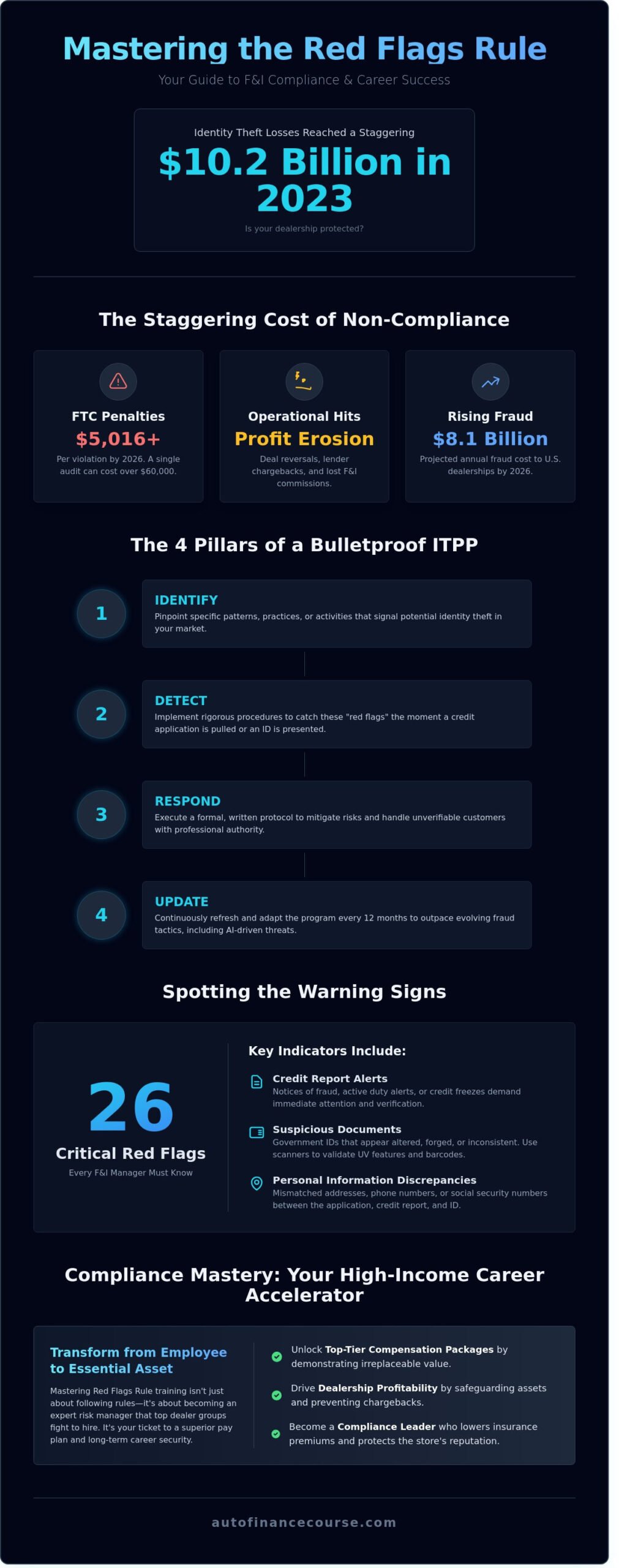
Federal regulators categorize identity theft indicators into 26 specific red flags. You must master these to protect your dealership and your career. Think of these as your professional radar. Effective red flags rule training for f&i managers separates the experts from the amateurs who risk everything on a bad deal. By 2026, the cost of a single compliance failure can exceed $50,000 in civil penalties, making your vigilance more valuable than ever.
Technology has changed the game. Fraudsters now use generative AI to create realistic utility bills and paystubs in seconds. You’ll often face the “ghost” credit file. This happens when a buyer has a Social Security number issued recently, but their credit history looks suspiciously established. In other cases, an out-of-state buyer might push for a remote delivery to avoid a face-to-face ID check. These aren’t just inconveniences; they’re high-level threats to your profitability.
Watch for addresses that don’t match the credit report or SSNs linked to deceased individuals. Synthetic identity fraud accounted for $2.4 billion in losses in 2023. You must look for inconsistent patterns. Does a 22-year-old applicant have a 15-year employment history? Does the SSN prefix match the applicant’s state of birth? Small details prevent massive compliance failures. Master these skills to ensure your high income career remains secure and profitable. Don’t let a “mismatched” data point slide just to close a unit.
Stop being a victim of “high-pressure” tactics. If a customer rushes you or acts offended by standard questions, slow down. Use this verification checklist for every deal:
If the ID feels wrong, it probably is. Trust your gut and your red flags rule training for f&i managers. Are you ready to lead your department with total confidence? Never let a pushy buyer bypass your security protocols. Your expertise is the final line of defense for the dealership’s assets.
A “one-and-done” approach to compliance is a fast track to a $51,744 fine per violation. Identity theft tactics evolve every 90 days, meaning a training session from last year won’t protect your profits in 2026. Effective red flags rule training for f&i managers must be an ongoing discipline, not a box you check once. You must integrate these checks directly into your standard F&I menu presentation. When compliance becomes part of your professional rhythm, it stops being a hurdle and starts being a tool for building trust.
Building a culture of compliance starts in the showroom. It’s about setting expectations early. If the sales team knows that every deal requires a verified government ID and a matching utility bill, the finance office runs like a well-oiled machine. This proactive stance protects the dealership and ensures a smooth transition for the buyer.
Your sales consultants are your first line of defense. Teach them to spot early warning signs during the test drive. Does the customer’s story about their trade-in change? Do they seem unusually rushed to skip the credit application? Standardize the document collection process for every single deal. By gathering clear, legible IDs and proof of residence before the customer even sees the F&I office, you reduce friction. This eliminates the “stop-and-start” rhythm that kills gross profit and customer satisfaction scores.
Stop relying on manual checks. Use modern F&I software to automate identity verification. These platforms scan databases in real-time to flag inconsistencies that the human eye misses. When you encounter “soft hits,” handle them with poise. Don’t accuse the customer; simply request secondary verification to protect their identity. Your Program Manager should audit your service providers every 180 days to ensure their security protocols are up to date. Automation ensures that red flags rule training for f&i managers translates into actual dealership security and long-term profitability.
Compliance isn’t just about avoiding legal trouble; it’s your most powerful tool for maximizing profitability. When you master red flags rule training for f&i managers, you protect the dealership’s bottom line and your own commission check. Dealerships lose an average of $11,000 per identity theft incident. By preventing these losses, you prove your value as a high-level asset. Use your certification to negotiate a pay plan that reflects your status as a risk-management expert. High-performing managers who prioritize compliance often see a 20% increase in lender approval rates because they submit clean, verified deals. Enroll in the Online F&I Manager Course to secure your spot at the top of the industry.
Learning compliance through trial and error is a recipe for disaster. One mistake can trigger federal fines exceeding $50,120 per violation. General Managers don’t want to hire a “work in progress” who might cost them a fortune in audits. They want a “Safe Bet” who hits the ground running on day one. Professional red flags rule training for f&i managers gives you the exact blueprint to handle sensitive data without hesitation. This expertise is the foundation for a career that consistently generates $150,000 or more in annual income. You’ll stop guessing and start performing like a seasoned pro.
Our curriculum at AutoFinanceCourse.com delivers the exact skills you need to dominate the F&I office. You get 180 days of full access to expert-led modules covering everything from identity theft prevention to advanced menu selling. This isn’t just a class; it’s an investment in your financial freedom. Dealerships are actively hunting for experts who can navigate the 2026 regulatory environment with confidence. Don’t wait for opportunity to find you. Start Now and transform your professional trajectory. Become the job-ready expert every dealer needs on their team.
Compliance is the bedrock of a successful career in the modern dealership. You’ve learned that mastering the 26 specific warning signs of identity theft isn’t just about following the law; it’s about protecting a business that generates millions in annual revenue. Federal regulations in 2026 demand absolute precision from every desk. When you prioritize red flags rule training for f&i managers, you transform yourself from a standard employee into an indispensable asset. Top-tier F&I managers often earn between $125,000 and $250,000 annually because they balance high-volume sales with bulletproof legal execution.
Don’t leave your professional growth to chance. Our comprehensive curriculum is built from actual F&I office experience to ensure you’re job-ready for the most prestigious dealerships in the country. You’ll get 180 days of full access to master every legal nuance and sales tactic required to dominate the field. This verified training provides the roadmap you need to secure your spot at the top of the organizational chart. Are you ready to claim your future?
Master F&I Compliance and Start Your High-Income Career!
Your journey toward a more lucrative and prestigious career starts today. Take the lead and master the skills that set the industry’s highest earners apart.
Yes, red flags rule training for f&i managers is mandatory under federal law 16 CFR Part 681. The Federal Trade Commission requires every financial institution and creditor to implement a written Identity Theft Prevention Program. Since your dealership extends or arranges credit, you must train all staff who handle customer accounts. Failing to comply results in penalties of $4,363 per violation as of 2024. Master these rules to protect your career.
You should conduct Red Flags Rule training at least once every 12 months to ensure peak compliance. While the FTC doesn’t set a rigid calendar, annual updates are the industry standard for protecting your dealership from $4,000 plus fines. New hires must complete their initial training within their first 30 days of employment. Regular refreshers keep your team sharp and ready to spot sophisticated identity theft attempts.
Failing to spot a red flag exposes your dealership to identity theft losses and FTC fines of $4,363 per occurrence. Beyond the money, a single missed flag can destroy your dealership’s reputation and lead to immediate termination for the manager involved. You’re the last line of defense. Master these skills to protect the store’s profitability and secure your position as a top-performing compliance expert.
The Red Flags Rule specifically targets covered accounts where credit is extended or arranged. While a pure cash transaction might not fall under this specific rule, 90% of dealership deals involve some form of credit application or deferred payment. If you’re handling a customer’s personal data to facilitate a transaction, you must follow your Identity Theft Prevention Program. Don’t risk a compliance breach by making assumptions.
The Red Flags Rule focuses on detecting identity theft before it happens; the Safeguards Rule dictates how you protect stored customer data. Think of Red Flags as the security guard checking IDs at the door and Safeguards as the vault where you keep the files. Both are essential for your career success. You need to master both 16 CFR Part 314 and Part 681 to be a truly elite F&I manager.
Yes, you can complete red flags rule training for f&i managers through our high-impact online portal. Online certification allows you to master compliance at your own pace while preparing for a high income career. Our 2026 updated modules provide the exact roadmap you need to handle real-world scenarios. Enroll now to gain the expert skills that top-tier dealerships demand from their management teams.
The FTC identifies 26 specific red flags, but the 3 most common are suspicious identification, inconsistent credit report data, and mismatched addresses. If a customer’s photo doesn’t match their physical appearance or their Social Security number was issued after their birth date, stop the deal. Watch for out of character credit activity, such as a sudden 200 point jump in a score or a brand-new credit history for an older buyer.
The dealership’s Board of Directors or a designated senior executive must oversee the development and implementation of the ITPP. They usually appoint a Compliance Officer to manage the daily operations and training schedules. As an F&I Manager, you’re the primary operator of this program. Your success depends on your ability to execute these federal requirements perfectly every single time you sit down with a customer.