

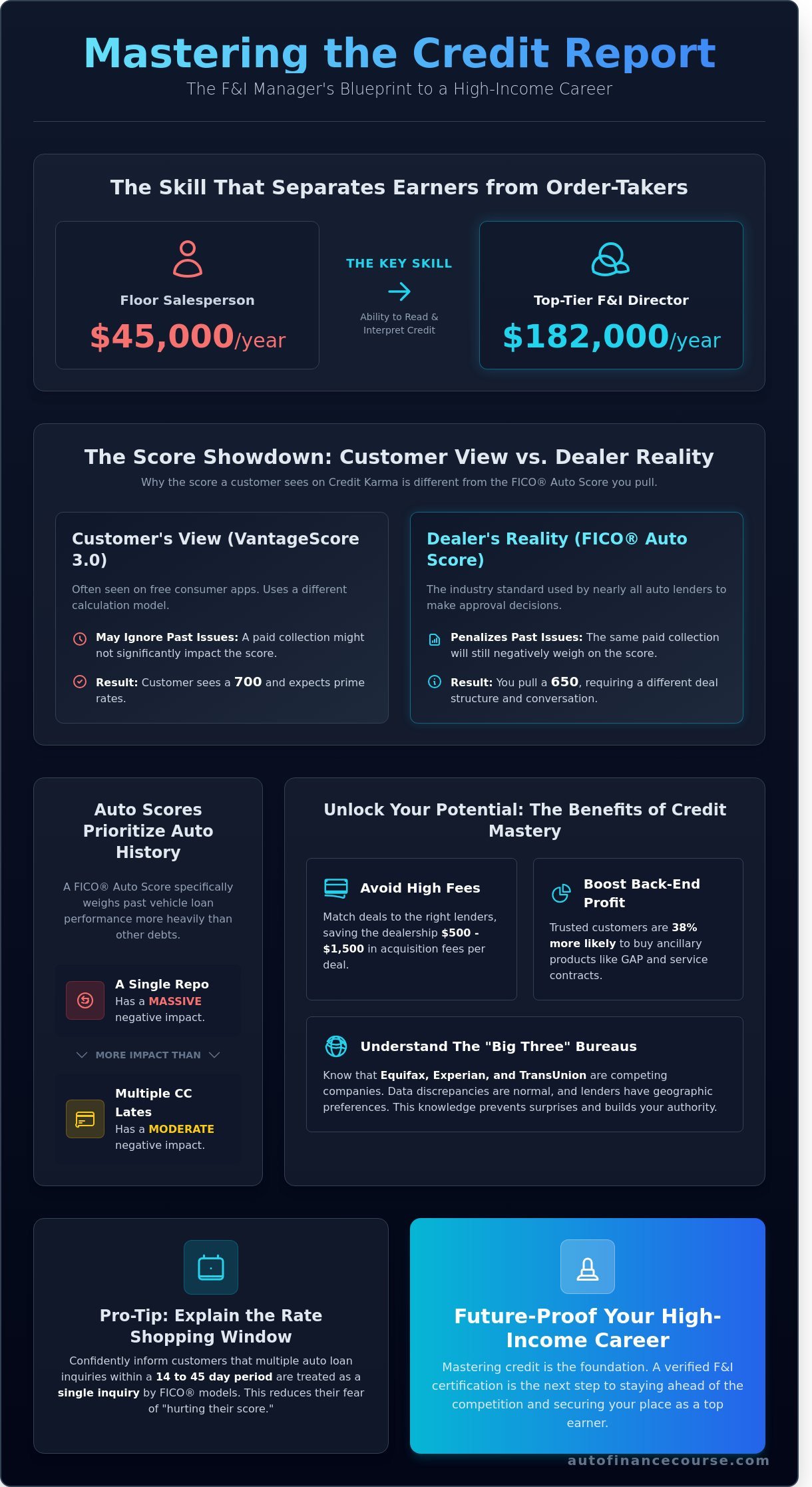
The difference between a $45,000 a year floor salesperson and a $182,000 per year F&I Director often comes down to a single skill: the ability to read between the lines of a credit pull. You’ve likely felt the frustration of staring at a 542 FICO Auto Score 8 while a customer insists their credit is “flawless.” It’s common to feel overwhelmed by industry jargon or the fear of losing a $3,200 back-end profit deal because you didn’t spot a hidden repossession. Master the art of understanding credit bureau reports for auto loans, and you stop being a paper pusher and start being a high-earning deal maker.
Are you ready to stop guessing and start closing? This guide will teach you to interpret credit data like a top-tier F&I Manager so you can secure more approvals and maximize dealership profitability. We’ll break down the 5 specific credit factors lenders prioritize and show you how to explain complex files to customers with confidence. We’re providing the exact framework used to structure deals that lenders actually buy. It’s time to unlock your high income career and drive your professional future forward today.
Think of the credit bureau report as the DNA of every car deal. It contains the genetic code that determines if a deal lives, dies, or thrives. To reach the top of this high-income career, you cannot be a mere “order taker” who simply hits the submit button. You must be an expert who deciphers the data. Mastering the art of understanding credit bureau reports for auto loans is what separates the top 5% of earners from the rest of the pack. It gives you the authority to control the desk and the deal.
Your ability to interpret this data directly impacts your Customer Satisfaction Index (CSI) scores. High CSI scores aren’t an accident; they are the result of clarity and transparency. When you explain a customer’s credit history with precision, you build immediate trust. This trust is the foundation for your back-end profit. Statistics show that a customer who trusts their F&I Manager is 38% more likely to invest in ancillary products like GAP insurance or service contracts. You aren’t just selling paper. You are providing a financial roadmap based on their specific history.
Stop looking at the three-digit score as the final answer. The score is just the cover of the book; the report is the story. A 640 score caused by a medical collection from June 2022 is vastly different from a 640 caused by three recent 30-day lates on a current auto loan. You must see the difference. By understanding credit bureau reports for auto loans, you position yourself as a consultant rather than a salesperson.
Profitability lives in the details of the tradelines. If you don’t know how to read the report, you’ll send deals to the wrong lenders. This results in high acquisition fees that can cost the dealership $500 to $1,500 per deal. Mastery allows you to secure better buy rates from your lending partners. When you know which bank favors a specific credit profile, you maximize your spread and your commission. This expertise is the core of your value. If you’re ready to master these skills, start by learning What is an F&I Manager? and how this role drives the entire dealership’s bottom line.
Equifax, Experian, and TransUnion aren’t government agencies. They’re private, competing corporations. They collect data independently; this is why a customer’s profile rarely looks identical across all three platforms. One bureau might have a 2022 late payment recorded while another doesn’t. Understanding credit bureau reports for auto loans starts with recognizing these data discrepancies. Most lenders don’t report to every bureau because it costs them money. Consequently, a “thin file” customer might have a 710 score on TransUnion but no score at all on Equifax.
You’ll often see a customer walk in with a 700 score from Credit Karma, only for your system to pull a 650. This happens because Credit Karma uses the VantageScore 3.0 model. Dealerships almost exclusively use FICO Auto Scores. These models are different math problems. While VantageScore might ignore a paid collection, a FICO Auto Score 8 will still penalize the borrower for it. To master the skills required for a high-income F&I career, you must explain these gaps to customers with total confidence.
Lenders don’t all use the same version of FICO. FICO Auto Score 8 is currently the industry standard. However, some legacy lenders still utilize FICO 2, 4, or 5. These older versions are the same ones used in mortgage lending. Newer models like FICO 9 and 10 are gaining traction because they treat medical debt more leniently. The “Auto” version of any FICO score is unique because it weights previous car payment history more heavily than a “Base” score. A repossession from 2020 will tank an Auto Score much harder than a standard credit card late payment.
Geography dictates which bureau a lender prefers. Experian holds roughly 55% of the market share in Western states like California and Arizona. Equifax remains the dominant force in the Southeast, particularly in Georgia and Florida. Captive lenders have clear favorites too. Toyota Financial Services frequently leans on Experian data. Ford Credit often pulls TransUnion or Experian depending on the specific region.
Success in the F&I office requires understanding credit bureau reports for auto loans at an expert level. When you can identify why a score dropped five points since last month, you gain the trust of both the lender and the customer. This technical expertise is the roadmap to increasing your profitability and securing a prestigious position in the dealership.
Mastering the art of understanding credit bureau reports for auto loans allows you to structure deals that actually get funded. Don’t just look at the score. You need to see the story behind the numbers. Follow this professional five step process to dissect any credit file in under 60 seconds.
Distinguish between installment and revolving debt immediately. Installment loans, like a previous 72 month auto finance contract, show the ability to commit to a fixed payment schedule. Revolving debt, such as a credit card with a $5,000 limit, reveals day to day financial discipline. Calculate the Debt-to-Income (DTI) ratio by dividing total monthly debt by gross income. Keep DTI under 40% for the best “buyability.” Aim for a Payment-to-Income (PTI) ratio below 15% for the new vehicle. Look for “Paid as Agreed” status in the 24 month history. A single “30 day late” in the last six months can drop a score by 80 points and move a customer from Tier 1 to Tier 3.
Watch for patterns that suggest a “straw purchase.” If a Tier 1 buyer with a 780 score is buying a subcompact car they clearly won’t drive, the lender will flag it. Identify recent bankruptcies. A Chapter 7 discharge stays on the report for 10 years, while a Chapter 13 remains for seven. A customer in an active Chapter 13 requires a “Motion to Incur Debt” from the court before you can close the deal. Don’t let these details catch you off guard. Master F&I Skills with our Online Course to learn how to handle these complex credit scenarios. Understanding credit bureau reports for auto loans is your first step toward a high income career in the dealership office.
Mastering the credit conversation is what separates average clerks from elite F&I Managers. You must explain the difference between hard and soft inquiries with total confidence to put your customer at ease. A soft inquiry occurs when a consumer checks their own score or a lender pre-approves an offer; it never impacts the numeric score. A hard inquiry happens when a lender pulls a report for a specific lending decision. Nervous customers often fear these pulls. You must educate them that credit bureaus actually expect consumers to shop for the best deal. This transparency is a vital part of understanding credit bureau reports for auto loans.
Modern scoring models like FICO 8 and VantageScore 4.0 utilize a specific window for auto loan inquiries. Multiple inquiries for the same loan type within a 14 to 45 day window generally count as a single scoring event. This allows you to use platforms like RouteOne or Dealertrack to submit an application to 5 or 6 different lenders simultaneously. It doesn’t destroy the customer’s credit profile. Instead, it creates a competitive environment where lenders fight to offer the lowest APR. Tell your customer that “shopping around” is the mark of a savvy buyer, not a desperate one.
Stop focusing on a 540 score and start looking at the human being behind the data. You aren’t just selling a vehicle; you’re selling a financial recovery tool. Use the “Credit Re-builder” pitch to show how 24 months of consistent, on-time auto payments can skyrocket their future borrowing power. When a customer says “Don’t run my credit yet,” be direct. Explain that attempting to secure a Tier 1 rate without a credit pull is like asking a doctor to perform surgery in the dark. You need the data to fight for their best interest.
Secure subprime approvals by highlighting stability over the raw number. A lender often prioritizes 5 years at a single residence and 3 years at the same job over a score dip caused by a 2021 medical bill. Write detailed “Deal Notes” to your bank analysts. Explain a single 30-day late payment as a one-time life event rather than a pattern of bad behavior. This level of advocacy is how you Master the skills for a high income career in the F&I office.
In 2026, the “fake it till you make it” approach is dead. Dealerships no longer have the patience to hold your hand through a six month learning curve. Relying solely on basic on-the-job training is a gamble that most ambitious professionals lose. You must be the expert before you ever sit in the manager’s chair. Mastering the technical side of the business is your ticket out of the sales floor grind. Specifically, understanding credit bureau reports for auto loans is what separates a $45,000 salesperson from a $150,000 F&I Manager.
When you master understanding credit bureau reports for auto loans, you gain the ability to spot lender-friendly data points that others miss. If you can look at a 620 TransUnion score and immediately identify the tier-climbing opportunities, you become indispensable to the desk. A verified F&I certification gives you a massive competitive edge. It tells general managers that you’re trained in compliance, deal structuring, and menu selling. You aren’t just looking for a job; you’re ready to protect the dealership’s license and maximize back-end profit from day one.
Our curriculum isn’t academic theory; it’s a real-world blueprint built by F&I Managers who have closed thousands of deals. You get 180 days of full access to master every nuance of the trade. Most of our students see a full return on their investment within their first 30 days of moving into the F&I office. The math is simple. Learn the skills, get the promotion, and watch your income skyrocket. We provide the roadmap; you provide the drive.
Waiting for a promotion is a losing strategy. Take control of your trajectory by becoming the most knowledgeable person in the dealership. If you’re ready to leave the lot behind, check out our Finance Manager Training Guide to see exactly how the transition works. This is the definitive path to a High Income Career.
Are you ready to master the art of the deal? Stop settling for average and start your journey toward a more lucrative future right now. Secure your spot and prove you have what it takes to lead the department. ENROLL NOW to secure your future.
You’ve gained the technical foundation to navigate FICO Auto Scores and the nuances of the three major bureaus. Mastering the art of understanding credit bureau reports for auto loans separates the top 1% of earners from those who simply process paperwork. You now understand how to spot opportunities in a credit file that others miss. This skill directly impacts your back-end gross and CSI scores. Don’t leave your professional growth to chance when the path to a six-figure salary is clearly mapped out. Our training provides 180 days of full access to elite strategies that build dealership-ready skills. This is your opportunity to secure a high-income career potential exceeding $150,000 per year. The industry’s most successful managers don’t wait for permission to excel; they take the initiative to master their craft. It’s your turn to step into the manager’s office with total confidence and authority.
ARE YOU READY TO MASTER F&I? ENROLL IN THE COMPLETE COURSE NOW!
Your journey to becoming a top-performing F&I leader starts right now.
Shopping for a car loan at multiple dealerships won’t hurt your score if you complete your applications within a 14 day window. Credit scoring models like FICO 8 treat multiple inquiries for the same loan type as a single event during this period. This allows you to hunt for the best rate without losing points. Master this timing to protect your credit profile while securing the most profitable deal for your future.
Most auto lenders in 2026 rely on Experian as their primary data provider. While TransUnion and Equifax remain relevant, Experian Auto 8 and 9 models are the industry standard for 55% of major finance companies. Understanding credit bureau reports for auto loans requires knowing which bureau your local lenders prefer. Ask your F&I Manager which report they pull to ensure your data is accurate before you sign.
You generally need a FICO Auto Score of 740 or higher to qualify for a 0% APR incentive. Lenders reserve these Tier 1 rates for the top 15% of applicants who demonstrate perfect payment history. If your score sits at 720, you might still secure a competitive 1.9% or 2.9% rate. Unlock your potential by monitoring your score and cleaning up small errors to hit that 740 benchmark and maximize your savings.
An expert F&I Manager can often secure financing just 1 day after a bankruptcy discharge. They use a network of subprime lenders who specialize in fresh start programs for buyers with Chapter 7 or Chapter 13 filings. Expect interest rates to range from 18% to 24% in these specific scenarios. This is a sought-after skill for managers who want to maximize dealership profitability while helping customers rebuild their financial lives.
The primary difference is that 90% of top lenders use FICO scores while VantageScore is more common for consumer-facing apps. FICO Auto Scores weigh your previous car payment history more heavily than a standard credit score does. VantageScore 4.0 can generate a score with only 1 month of credit history, whereas FICO requires 6 months. Mastering the nuances of understanding credit bureau reports for auto loans helps you predict which score a lender will prioritize.
Hard inquiries from car shopping stay on your credit report for 24 months. However, these inquiries only impact your actual FICO score for the first 12 months. After 365 days, the inquiry is visible but carries zero weight in the calculation. Focus on your long-term success by limiting credit applications to 3 or 4 per year to keep your report clean and professional. This strategy ensures you remain a prime candidate for the best rates.
F&I Managers watch for repossessions within the last 2 years and any 30-day late payments in the past 6 months. These red flags signal high risk and can drop your approval odds by 40% or more. They also look for straw purchase indicators, such as multiple active auto loans for a single driver. Build the skills to identify these issues early so you can address them with the lender and save the deal.
A top-performing F&I Manager must have 100% mastery of credit compliance laws like the Fair Credit Reporting Act and Regulation Z. Failure to follow these rules can result in fines of $16,000 per violation for the dealership. Investing in expert training ensures you stay compliant while driving record-breaking profitability. Are you ready to master these regulations and protect your high income career? Start your journey toward becoming a compliance expert today.